
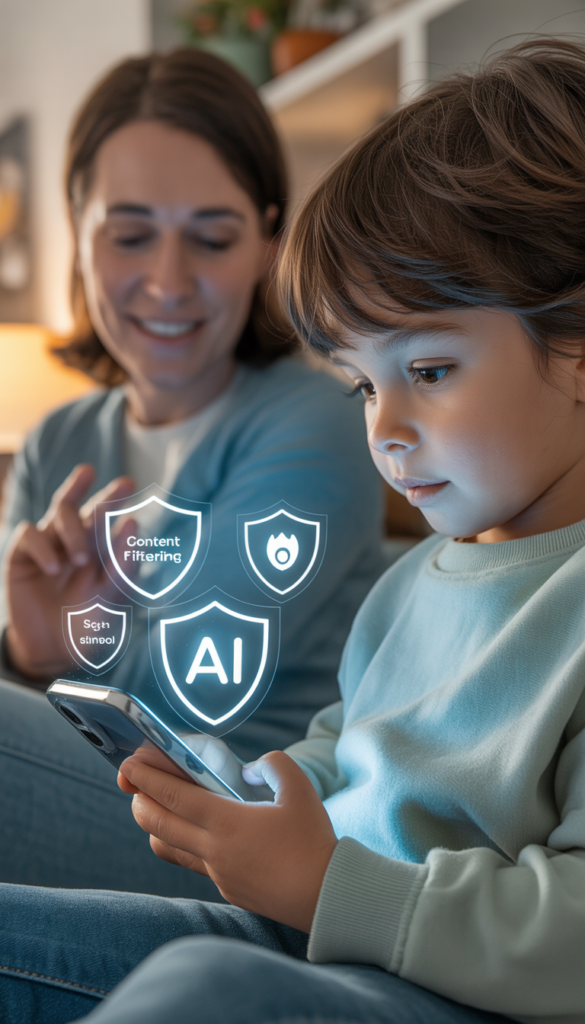
You hand your 10-year-old their first smartphone. You’ve set up the basic parental controls, blocked a few websites, and feel reasonably confident. But deep down, you know the truth: the internet is vast, unpredictable, and changes faster than any static setting can handle.
Here’s the reality: According to Common Sense Media’s research, tweens (ages 8-12) average about 5.5 hours of screen media daily, while teens (13-18) average closer to 8.5 hours. A 2025 study of Instagram Teen Accounts found that 58% of 13- to 15-year-olds had encountered unsafe content or unwanted messages within just six months — even with safety tools active (Meta disputed the findings, calling the report “deeply subjective”). Traditional parental control apps, with their rigid rules and endless configuration menus, are struggling to keep up.
This is where AI smartphone safety for kids in 2026 changes everything. Instead of parents fighting a constant battle against evolving digital dangers, artificial intelligence now works silently in the background, understanding context, detecting subtle risks, and protecting children in ways that static parental controls never could. The smartphone transforms from a source of parental anxiety into an intelligent guardian.
For a broader understanding of how AI is making devices more protective overall, check out our guide on How AI Is Transforming Smartphone Security in 2026.
How AI Understands Children’s Online Behavior
The fundamental shift in 2026 is this: AI doesn’t just block—it understands. Instead of relying on parents to manually blacklist websites or apps, modern smartphone AI learns what’s normal for each child and detects anomalies that signal danger.
Smart Pattern Recognition, Not Spying
AI smartphone safety for kids in 2026 operates on three principles:
Context Over Content: The AI doesn’t need to read your child’s messages to protect them. It analyzes patterns—who they communicate with, how frequently, at what times, and whether those patterns suddenly change.
Behavioral Baselines: Every child has a digital fingerprint. The AI learns when your child typically uses apps, what kind of content they engage with, and their normal communication circles.
Anomaly Detection: When a stranger suddenly contacts your child late at night, or when a gaming app starts requesting unusual permissions, the AI recognizes these as deviations from normal patterns and takes appropriate action.
Detecting Risky Apps and Content
Traditional parental controls rely on pre-made blocklists that are outdated within hours. AI-powered systems:
- Analyze app behavior before installation, identifying apps that exhibit predatory patterns even if they’re not officially classified as dangerous
- Scan images and videos locally on the device (not in the cloud) to detect inappropriate content while preserving privacy
- Evaluate social interactions for signs of grooming, bullying, or coercion without exposing private conversation content
Learning Daily Habits
Over 7-14 days, the AI builds a comprehensive understanding of your child’s digital life:
- When they do homework versus when they relax
- Which educational apps they genuinely use versus which they ignore
- Their typical locations and routines
- Healthy versus concerning communication patterns
This baseline allows the system to detect subtle shifts that might indicate problems—a sudden change in sleep schedule, withdrawal from social apps, or late-night activity spikes.
Smart Content Filtering in 2026 Smartphones
Gone are the days of accidentally blocking educational content while letting harmful material slip through. AI-powered content filtering is contextually aware and remarkably accurate.
Blocking Harmful Videos Automatically
YouTube, TikTok, and other platforms host billions of hours of content. AI smartphone safety for kids in 2026 provides real-time protection:
Visual Analysis: The AI analyzes video thumbnails and key frames locally, identifying mature themes before your child ever clicks play.
Audio Scanning: Speech-to-text analysis runs on-device, detecting inappropriate language or topics without sending recordings to external servers.
Context Understanding: The system distinguishes between educational content about human anatomy and sexually suggestive material, between documentary violence and gratuitous gore.
Age-Based AI Control
One-size-fits-all doesn’t work for children aged 7 versus 16. Modern AI systems:
- Automatically adjust restriction levels based on the child’s age and demonstrated maturity
- Recognize educational contexts—allowing a teenager to research sensitive topics for school projects while still blocking exploitative content
- Learn from exceptions—when parents override a block, the AI incorporates that feedback into future decisions
Real-Time Protection
Unlike traditional filters that check against databases, AI protection operates in real-time:
- A live stream that turns inappropriate is detected within seconds
- Newly uploaded harmful content is analyzed on the fly, not after thousands of complaints
- Emerging online challenges and dangerous trends are recognized through pattern analysis
AI Screen Time Management: No More Phone Addiction
Perhaps the biggest parental frustration isn’t what kids access—it’s how much time they spend accessing it. AI transforms screen time management from rigid timers to intelligent usage coaching.
AI Detects Overuse, Not Just Usage
Traditional screen time limits are blunt instruments: “2 hours, then lock.” Kids quickly learn to game the system. AI smartphone safety for kids in 2026 takes a more sophisticated approach:
Quality Over Quantity: The AI distinguishes between productive screen time (educational apps, creative tools, meaningful communication) and passive consumption (mindless scrolling, repetitive gaming).
Fatigue Recognition: Using typing patterns, interaction speed, and even micro-expressions from the selfie camera (with privacy protection), AI detects when your child is actually tired versus simply bored.
Context-Aware Limits: More screen time is permitted on weekends and holidays; less during school weeks. The system understands that a 3-hour creative coding session is different from 3 hours of TikTok.
Google’s own Family Link already builds on this idea, letting parents set daily time limits with separate School Time and Downtime schedules — the kind of context-aware foundation that AI-powered systems are now building on top of.
Smart Break Reminders
Instead of jarring, sudden lockouts that provoke arguments, AI provides:
- Gentle, escalating nudges—starting with subtle on-screen suggestions before enforcing breaks
- Optimal timing—waiting for natural pause points in gameplay or video watching
- Positive reinforcement—celebrating when children voluntarily put down their devices
Healthy Usage Balance
The goal isn’t zero screen time; it’s balanced screen time. AI helps by:
- Suggesting alternative activities based on your child’s interests—if they love photography, it might suggest a photo walk
- Tracking variety—ensuring your child engages with different types of content rather than fixating on a single app
- Family coordination—helping synchronize screen-free family time across multiple devices
AI Alerts for Parents: Instant Safety Updates
No parent can watch over their child’s shoulder 24/7. AI serves as a tireless digital guardian, alerting you only when genuine concerns arise.
Location Safety Intelligence
Modern location tracking goes beyond simple GPS boundaries:
- Pattern recognition alerts you if your child deviates from their normal routine unexpectedly
- Companion analysis detects if your child is consistently in the same location as an unfamiliar adult
- Predictive safety can identify potentially unsafe areas based on crime data and time of day
Stranger Contact Detection
This is perhaps the most sophisticated AI smartphone safety for kids in 2026 feature:
Communication Pattern Analysis: Without reading message content, AI analyzes frequency, timing, and response patterns. A sudden influx of messages from an unknown number at 11 PM triggers an alert.
Social Graph Mapping: The AI understands your child’s genuine social circles—classmates, family, established friends. New contacts outside these circles receive additional scrutiny.
Grooming Behavior Recognition: Certain interaction patterns—excessive flattery, requests for secrecy, attempts to isolate the child from existing friends—are recognized as potential grooming indicators.
Emergency AI Responses
When serious threats are detected, the system can:
- Immediately notify parents with specific, actionable information
- Escalate within the device—locking sensitive apps or limiting communication capabilities
- Coordinate with emergency services in extreme situations, sharing location and context
Real Benefits for Families
The shift from manual parental controls to AI smartphone safety for kids in 2026 delivers tangible improvements for everyone in the family.
Less Stress for Parents
Instead of constantly monitoring, configuring, and arguing:
- Peace of mind comes from knowing intelligent systems are working continuously
- Reduced conflict because AI interventions are objective and consistent, not perceived as parental nagging
- Time savings—parents spend minutes reviewing alerts rather than hours tweaking settings
Safer Digital Environment
Children benefit from:
- Protection from evolving threats that static controls miss
- Preserved privacy—AI works locally, not by exposing children’s activities to cloud servers
- Graduated independence—as children demonstrate responsibility, restrictions ease automatically
Kids Learn Responsibly
The ultimate goal isn’t eternal surveillance—it’s teaching digital self-regulation:
- Explanations accompany restrictions—”Your phone suggests a break because you’ve been watching videos for two hours”
- Positive modeling—AI demonstrates healthy digital habits through its own behavior
- Self-awareness tools—children can see their own usage patterns and set personal goals
Curious about which smartphones offer the best child safety features at different price points? Our Best Budget Smartphones in 2026 guide breaks down which affordable models include robust AI parental controls.
Budget vs. Flagship: AI Child Safety Comparison
| Safety Feature | Budget Phones ($200-$400) | Mid-Range Phones ($400-$700) | Flagship Phones ($700+) |
|---|---|---|---|
| Content Filtering | Basic website/app blocking | AI-enhanced smart filtering | Real-time contextual filtering |
| Screen Time AI | Simple usage timers | Activity-aware limits | Fatigue detection + smart breaks |
| Location Safety | Basic GPS tracking | Pattern-based alerts | Predictive safety + companion detection |
| Stranger Contact | Manual blocklists | Communication pattern analysis | Advanced grooming behavior recognition |
| Parent Dashboard | Standard reports | AI-powered insights & alerts | Real-time intelligent notifications |
| Privacy Architecture | Basic on-device processing | Enhanced local AI | Full on-device with differential privacy |
The Bottom Line: Even budget phones now offer meaningful AI child safety features. Mid-range devices provide the best balance of comprehensive protection and affordability for most families. For a complete look at how personalization features differ across price segments, see our How AI Personalization Is Making Smartphones Smarter in 2026 guide.
Future of AI Child Protection on Smartphones
The evolution of AI smartphone safety for kids in 2026 continues toward even more sophisticated, proactive protection.
Emotional Wellbeing Monitoring
Future systems may detect signs of cyberbullying, anxiety, or depression through subtle behavioral changes—withdrawn communication patterns, altered typing rhythms, or changes in app usage—and suggest appropriate interventions or parental check-ins.
Cross-Platform Safety Networks
Your child’s safety profile could work across devices—phone, tablet, laptop, and smartwatch—providing consistent protection regardless of which screen they’re using.
Collaborative Intelligence
With strict privacy safeguards, anonymized threat patterns detected on one child’s device could help protect others from similar emerging dangers.
Digital Literacy Integration
AI won’t just block dangers—it will teach children to recognize them, providing in-the-moment education about why certain content or contacts are inappropriate.
FAQ: Your AI Child Safety Questions Answered
Q1: Are AI parental controls better than traditional parental control apps?
Yes, fundamentally. Traditional apps rely on static rules and blocklists that are always playing catch-up. AI smartphone safety for kids in 2026 is proactive and adaptive—it learns normal patterns, detects anomalies, and protects against threats that haven’t even been catalogued yet.
Q2: Can AI block inappropriate content automatically without false positives?
Modern systems achieve high accuracy through contextual understanding, though no filter is completely perfect. While no filter is perfect, AI dramatically reduces both false positives (blocking educational content) and false negatives (missing harmful material). Most systems allow parents to review and adjust borderline cases.
Q3: Is AI monitoring safe for my child’s privacy?
Reputable systems process all sensitive data on-device, meaning your child’s photos, messages, and browsing history never leave their phone. The AI learns patterns, not content. Look for phones that emphasize “on-device processing” and provide transparent privacy controls.
Q4: Will my teenager feel like I’m spying on them?
This is the beauty of modern AI safety—it focuses on behavior patterns rather than content. You’re not reading their messages; you’re being alerted if communication patterns become concerning. Many systems also give teenagers visibility into what safety features are active, reducing the “spying” perception.
Q5: What age should I start using AI parental controls?
Most experts recommend graduated protection: comprehensive filtering for younger children (7-11), evolving into safety monitoring with increasing independence for teens (12-17). The best AI systems adjust their protection level based on the child’s age and demonstrated responsibility.
Q6: Do these features drain battery life?
Modern AI processors (NPUs) are specifically designed to handle these tasks with minimal power consumption—typically a small additional battery cost for full-time protection.
Conclusion: Why AI Safety Will Be Essential in 2026
Here’s the honest truth: the digital world isn’t getting simpler. New apps, platforms, and online challenges emerge constantly. Static parental controls—the kind you set up once and hope for the best—are becoming obsolete the moment you configure them.
AI smartphone safety for kids in 2026 represents the only scalable solution to this accelerating complexity. Instead of asking parents to fight a never-ending battle against every new threat, AI systems learn, adapt, and protect autonomously. They work alongside parental involvement, making it more effective. allowing you to focus on meaningful conversations rather than technical configurations.
The best safety features know when to protect and when to give your child space to grow — that matters more than how much content gets blocked. Modern AI child safety systems understand this balance intuitively, providing robust protection without suffocating supervision.
For parents navigating this new landscape, the message is reassuring: you don’t have to do it all alone. Your children’s smartphones are evolving into partners in their protection—intelligent guardians that work alongside you, not against your kids.
The future of parenting in the digital age is smarter technology that understands context, respects privacy, and helps children build healthy relationships with their devices — instead of more screen time arguments.. In 2026, that future is finally here.

Baqir Ali is the Founder of Baqir Digital Hub and a passionate SEO, AI, and Blogging specialist. With years of experience in digital marketing, he helps beginners and professionals grow online using smart content strategies, AI tools, and SEO best practices. His mission is to simplify technology and help people build sustainable online income.