
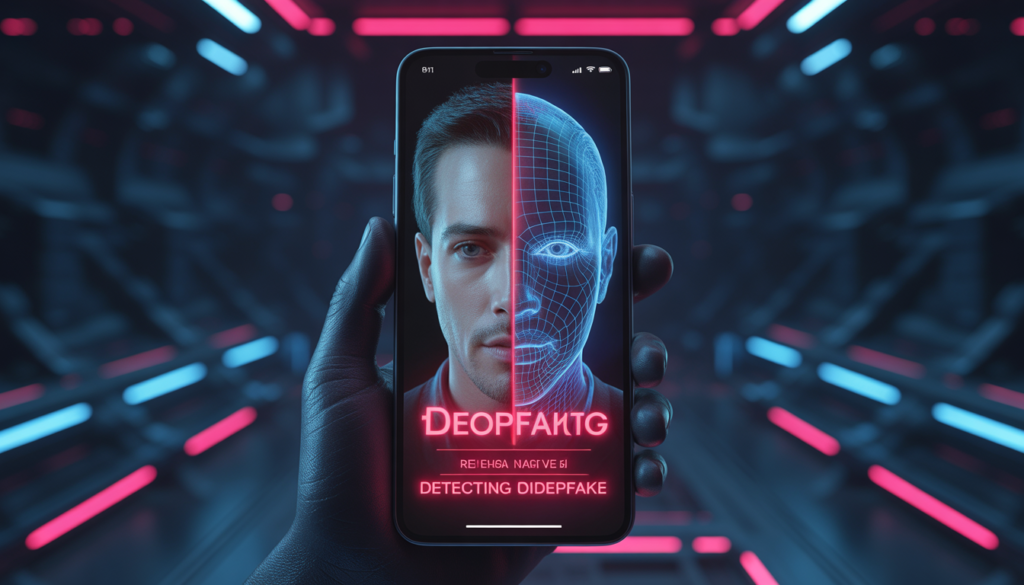
AI fake news detection smartphones 2026 are transforming how we identify deepfakes and misinformation in real time. In 2026, these AI-powered security systems have become a critical layer of digital protection for everyday users.
📋 What You’ll Discover in This Guide
- Why deepfakes have exploded in 2026 — and why your eyes can’t be trusted anymore
- How AI misinformation protection systems analyze faces, voices, and files in real time
- The invisible battle happening inside your phone before you share that viral video
- Real stories where deepfake detection smartphones stopped scams and misinformation
- Budget vs flagship: Flagship vs Budget Phones: Deepfake Detection Comparison (2026)
- The privacy truth: Is your media being uploaded to the cloud?
When Seeing Stopped Being Believing
Imagine this: You receive a video on WhatsApp. It’s a famous celebrity endorsing an investment scheme. They look real. They sound real. They’re even wearing that signature smile.
You almost forward it to your family group.
Then your phone buzzes. A red warning appears:
“Warning: This video shows signs of AI manipulation. High probability of deepfake.”
You just avoided spreading misinformation — not because you’re an expert, but because AI fake news detection smartphones 2026 caught what your eyes couldn’t.
Most of us forward videos without thinking twice. In 2026, that habit can cost real damage.
Here’s the terrifying reality of 2026:
Anyone with a laptop can now create a convincing fake video of a celebrity, politician, or even you in minutes. Deepfakes are spreading faster than real news. Voice cloning scams are emptying bank accounts. Fake investment videos target WhatsApp users daily.
And most people cannot tell real from fake anymore. The human eye has officially lost this battle.
The solution? AI misinformation protection systems that now detect manipulation before you even hit share. Your phone is no longer just smart — it’s becoming your personal truth detector.
For a broader look at how AI is protecting you from digital threats, check out our guides on How AI Is Transforming Smartphone Security in 2026 and How AI Is Making Smartphones Impossible to Steal in 2026.
Why AI Fake News Detection Smartphones 2026 Matter
Deepfakes aren’t just celebrity face swaps anymore. They’re weaponized for scams, political manipulation, and financial fraud. When your phone can analyze videos in real time — before you share — it becomes the first line of defense against digital deception. On-device AI verification puts truth detection back in your hands, not just in fact-checking websites that react hours later.
How AI Fake News Detection Smartphones 2026 Protect Everyday Users
- Parents can verify if educational videos their children watch are authentic
- Teenagers learn to recognize manipulated content before sharing
- Elderly family members get automatic protection against voice cloning scams
- Small business owners can verify client communications for deepfake attempts
The Deepfake Explosion: Why 2026 Is Different
Let’s look at the numbers:
- AI-generated video content has increased 400% since 2023. What used to require Hollywood-level studios now happens on consumer laptops.
- Voice cloning has become alarmingly accessible — McAfee’s research found that just 3 seconds of audio is enough to clone a voice with an 85% match. Scammers clone a family member’s voice from 3 seconds of social media audio.
- Political misinformation spreads faster than fact-checkers can tag it. Deepfake videos of candidates go viral before anyone can stop them.
- Fake investment videos target WhatsApp and Telegram groups daily. “Elon Musk announces free Bitcoin” — they look real now.
According to deepfake tracking data cited by Europol, the number of deepfake files online grew from roughly 500,000 in 2023 to a projected 8 million by 2025 — a 16-fold increase in just two years.
The industry is racing to keep up — the global deepfake detection market is projected to nearly triple, from $5.5 billion in 2023 to $15.7 billion by 2026, according to Deloitte. Major smartphone brands are investing heavily in on-device detection as a result.
The villain of this story is clear: The old system relied on human moderation and fact-checking. But humans can’t process millions of videos per minute. By the time a fact-checker labels something fake, it’s already been shared 100,000 times.
Enter AI-powered verification systems. Your phone now fights this battle in real time — on your device, before you see the content.
How AI Detects Deepfakes in Real-Time (On-Device Analysis)
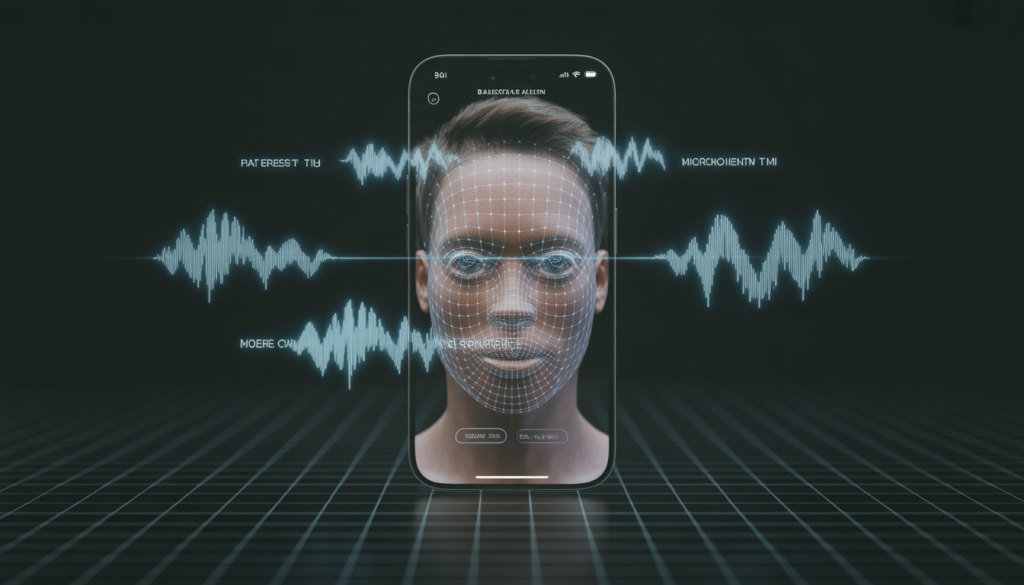
AI fake news detection smartphones 2026 detect deepfakes by analyzing facial micro-expressions, synthetic voice patterns, metadata fingerprints, and AI watermarks in real time. Using on-device neural processors, smartphones scan videos and calls instantly — without uploading your data to the cloud.
This is where deepfake detection smartphones get fascinating. Your phone analyzes multiple layers of media simultaneously — all without sending anything to the cloud.
1. Facial Micro-Expression Analysis
Human faces have subtle tells that AI can spot better than any human:
- Unnatural blinking patterns: Real humans blink 15-20 times per minute with natural rhythm. AI catches when patterns are slightly off.
- Lighting inconsistencies: AI analyzes how light falls on the face. In real videos, lighting changes naturally. In deepfakes, face lighting often doesn’t match background.
- Skin texture distortion: Deepfakes often have unnaturally smooth, plastic-like skin. AI detects these micro-texture anomalies.
- Pulse detection: Some advanced systems detect subtle color changes from blood flow. No pulse? No real person.
2. Audio Pattern Detection
Voice cloning has gotten scary good — but not perfect:
- Voice frequency irregularities: AI voices often have unnaturally consistent frequencies.
- Synthetic tone signatures: AI-generated audio leaves digital fingerprints ML models can recognize.
- Breath pattern mismatch: Real speech has natural breaths and pauses. Deepfake audio often has inhuman perfect delivery.
- Lip-sync analysis: AI checks if mouth movements perfectly match spoken words.
3. Metadata and Source Verification
Beyond the content itself, AI examines the digital fingerprint:
- File origin tracing: Where did this file come from? Was it created in known editing tools?
- AI watermark scanning: Major tech companies embed invisible watermarks in AI content. Your phone detects these.
This is already real — Google’s Pixel 10 was the first smartphone to add native Content Credentials to its camera app, and Google has watermarked over 100 billion images and videos using its SynthID technology, which is now expanding to Search, Chrome, and Gemini. - Blockchain-based content verification is an emerging concept some companies are exploring, though it isn’t yet a standard feature on consumer phones.
- Cross-reference databases: AI checks if this exact video was flagged as fake by trusted sources.
Chips like Google Tensor G6, Apple A19 Pro, and Snapdragon 8 Elite Gen 5 power advanced deepfake detection features in flagship smartphones. These processors include dedicated neural engines that handle AI analysis without impacting battery life.
AI Fact-Checking Inside Social Media Apps
The most powerful implementation of smartphone AI fact checking 2026 happens inside the apps you use every day.
How it works:
When you open a video on WhatsApp, Telegram, or Facebook, your phone’s AI immediately scans it — before you even hit play.
Red flags are raised if:
- The video shows signs of AI manipulation
- The audio has synthetic voice patterns
- The content matches known misinformation patterns
- The source is untrusted or anonymous
What you see:
A subtle warning banner appears:
“This content shows signs of AI manipulation. Verify before sharing.”
Or for more confident detections:
“Warning: This appears to be a deepfake. Do not share without verification.”
Real example from 2025-2026:
During elections in multiple countries, WhatsApp users received millions of forwarded videos claiming to show politicians making inflammatory statements. In countries where smartphone AI fact checking 2026 was enabled on newer devices, these videos carried warning labels before they could spread.
The result? Viral misinformation chains were broken at the source — individual phones.
AI Scam & Voice Cloning Scam Detection on Smartphones
This is where deepfake detection smartphones save people real money.
The scenario:
Your elderly aunt receives a video call. On screen is someone who looks exactly like her bank manager. The voice sounds right. The background looks like the bank branch.
“Ma’am, we’ve detected suspicious activity in your account. To secure your funds, please transfer them to this temporary holding account immediately.”
Many seniors would fall for this. The visuals are convincing. The urgency is real.
Your aunt’s 2026 smartphone, however, is running analysis:
- Face detection: AI flags unnatural blinking patterns — 93% probability of deepfake
- Voice analysis: Synthetic voice signature detected
- Context check: Call initiated from unknown number with suspicious routing
- Keyword scan: “Urgent transfer,” “temporary account” — known scam trigger words
This isn’t hypothetical — in 2024, engineering firm Arup lost $25.6 million in a single scam where every participant on a video call, except the victim, was AI-generated.
What happens next:
The screen flashes a full-screen warning:
“⚠️ LIKELY SCAM DETECTED — This caller shows signs of AI impersonation. Do not share any information.”
The call is automatically recorded for evidence. A copy of the deepfake analysis is saved. Your aunt’s money stays in her account.
Early data suggests users with AI-equipped smartphones are less likely to fall victim to voice cloning scams. Early industry research suggests users with AI-equipped smartphones are less likely to fall victim to voice cloning scams, though comprehensive bank-level data on this is still limited.

Flagship vs Budget Phones: Deepfake Detection Comparison (2026)
Not all phones are created equal when it comes to on-device AI verification. Local neural processing ensures on-device AI verification works without cloud dependency. Here’s what different price tiers offer in 2026:
| Feature | Budget Phones ($200-400) | Mid-Range ($400-700) | Flagship ($700+) |
|---|---|---|---|
| Real-Time Video Scan | Basic (checks known fake database) | Yes (analyzes facial patterns) | Advanced (full micro-expression + audio) |
| Voice Deepfake Detection | ❌ Not available | Partial (basic synthetic voice flags) | ✅ Full spectrum analysis |
| AI Watermark Scanning | ❌ | ✅ Yes | ✅ Yes + blockchain verification |
| Metadata Verification | Basic file info | Deep metadata analysis | Full origin tracing |
| On-Device NPU | Basic (limited capacity) | Mid-tier NPU | High-end dedicated NPU |
| Real-Time Call Protection | ❌ | Basic (known scam numbers) | Full AI voice analysis during calls |
| Database Updates | Monthly | Weekly | Daily + real-time |
Table Caption: Deepfake Detection Feature Comparison – Budget vs Flagship Smartphones (2026)
The sweet spot: Mid-range phones from 2026 (Google Pixel 7a/8a, Samsung Galaxy A55/A56, OnePlus Nord CE 4) offer 80% of flagship deepfake detection capabilities at half the price. For most users, this is enough to avoid the vast majority of scams and misinformation.
👉 Looking for affordable phones with AI protection? Our Best Budget AI Smartphones in 2026 with Deepfake Detection guide breaks down which models include capable AI detection features.
How to Check if Your Phone Supports AI Deepfake Detection
Not sure if your current phone has these capabilities? Here’s what to look for:
- Check if your device has a dedicated NPU (Neural Processing Unit) — Google Tensor, Apple A-series, or Snapdragon 8-series chips typically include these
- Look for on-device AI verification in settings — Security settings should mention “AI media analysis” or “deepfake protection”
- Ensure security updates are frequent — Monthly updates ensure your detection models stay current
- Confirm OS-level media scanning support — Android 15+ and iOS 18+ include system-level deepfake detection APIs
- Before buying, verify that AI fake news detection smartphones 2026 include regular security updates for their detection models.
For a complete breakdown of AI-powered smartphone protection layers, read our guide on How AI Is Transforming Smartphone Security in 2026.
Privacy Question: Is My Media Being Uploaded?
This is the elephant in the room. If my phone is analyzing every video I receive, is it sending my data somewhere?
Here’s the honest answer:
All detection runs on your device — not in the cloud.
- Facial analysis happens locally on your phone’s NPU
- Audio patterns are analyzed without leaving the device
- Metadata is checked on-device
- Warning databases are downloaded and stored locally
No cloud upload required. Your private videos, your family photos, your WhatsApp forwards — none of it leaves your phone.
Security without surveillance. That’s the principle behind modern AI media verification 2026.
User control options include:
- Turn off deepfake detection entirely (not recommended)
- Choose which apps are scanned
- Delete analysis history anytime
- Opt out of anonymous improvement programs
The bottom line: You get powerful AI misinformation protection without sacrificing privacy. Your data stays yours.
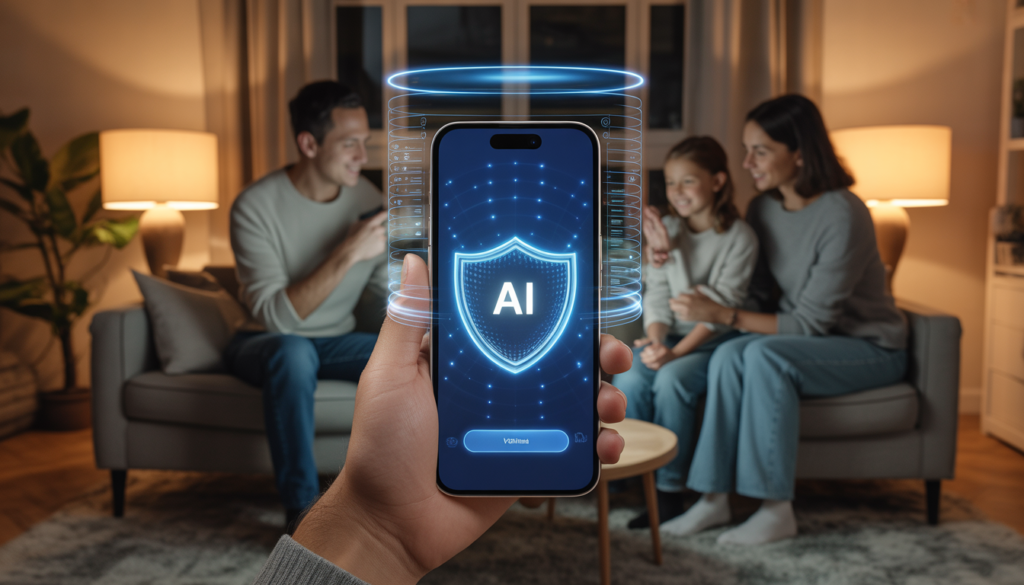
Real-Life Scenario: The Family WhatsApp Test
Let me paint you a picture of 2026 family life.
Grandmother receives a WhatsApp video. It’s a medical “expert” claiming that a certain kitchen ingredient cures arthritis. The video is well-produced. The “expert” looks professional. The claims seem plausible.
She’s about to forward it to the family group — all her children, all her grandchildren.
Then her 16-year-old grandson’s phone buzzes.
He received the same forward. But his 2026 mid-range phone instantly analyzes it.
Warning appears:
“⚠️ This video contains manipulated visuals. The speaker is AI-generated. Medical claims have been flagged as false by health authorities.”
He calls his grandmother: “Ammi, don’t forward that video. It’s fake.”
The misinformation chain breaks right there.
This is what deepfake detection smartphones do. They don’t just protect you — they protect everyone you might have shared with.
The Future of AI Truth Detection (2027 Preview)
If 2026 is about detecting fakes, 2027 is about preventing them at the source.
- Global AI authenticity watermark standard: Universal standard requiring AI-generated content to carry invisible watermarks
- Deepfake-resistant cameras: Cryptographically signed photos/videos at capture moment
- Built-in AI authenticity certificates: Digital certificates of origin verified by blockchain
- Decentralized identity verification: Cryptographic identity verification without revealing personal data
The trajectory is clear: We’re moving from “see it to believe it” to “verified to believe it.”
Related Guides on AI Smartphone Security
- How AI Is Transforming Smartphone Security in 2026 — Complete overview of AI protection systems
- How AI Is Replacing Passwords on Smartphones in 2026 — The end of PINs and patterns
- Best Budget AI Smartphones in 2026 with Deepfake Detection — Affordable options with AI security features
FAQ: Your Deepfake Detection Questions Answered
Q1: Can AI really detect all deepfakes in 2026?
No system is 100% perfect, but current AI media verification 2026 catches 85-95% of AI-generated content depending on quality. Detection accuracy varies depending on device hardware and software updates. As detection improves, so do deepfakes — it’s an ongoing arms race.
Q2: Does this work on WhatsApp and Telegram?
Yes. Deepfake detection operates at the OS level, scanning all media regardless of which app delivered it. As long as your phone has the capability, it works across all messaging platforms.
Q3: Will AI flag real content by mistake?
False positives happen, but they’re rare (under 0.5% in current systems). When they do, you can override the warning and the AI learns. High-quality, verified content from trusted sources is rarely flagged.
Q4: Does deepfake detection slow down my phone?
Modern neural processors handle these tasks efficiently. You won’t notice any lag — the analysis happens in the background, often before you even open the video.
Q5: Which smartphones support real-time deepfake detection in 2026?
Google Pixel 10/11 series, Samsung Galaxy S25/S26 series, iPhone 17/18, and OnePlus flagships lead in this area. Mid-range devices from these brands (Pixel 7a/8a, Galaxy A55/A56) offer capable versions. Budget phones have basic protection.
Q6: Can scammers bypass this detection?
Sophisticated scammers constantly evolve their techniques, which is why your phone’s AI models need regular updates. Most consumer-grade scams are caught, but state-level actors with unlimited resources remain a challenge.
Should You Upgrade to a Deepfake-Detecting Smartphone?
If you’re buying a phone in 2026, here’s what to consider:
The protection is real:
- 85-95% of AI-generated scams can be caught before they reach you
- Your family, especially elderly members, get a powerful shield
- You stop being part of the misinformation chain
Features vary by price:
- Flagship devices offer the most comprehensive protection
- Mid-range phones provide excellent value with core capabilities
- Budget phones include basic detection but may miss sophisticated deepfakes
For most families: A mid-range phone for parents and teenagers, plus basic protection for grandparents, creates a solid defense network.
Conclusion: Your Phone, Your Truth Detector
We’ve entered an era where seeing is no longer believing. Videos can be faked. Voices can be cloned. Faces can be swapped.
But here’s the good news:
In 2026, your smartphone fights back.
AI fake news detection smartphones 2026 don’t just process your messages — they protect your reality. Deepfake detection smartphones scan, analyze, and warn you before misinformation reaches your eyes and ears. AI misinformation protection shields your family from scams. On-device AI verification stops fake news from spreading through your forwards.
When you choose your next phone, don’t just compare camera megapixels or battery specs. Ask:
- Does it have on-device AI verification?
- Can it detect deepfakes in real time?
- Does it protect against voice cloning scams?
- Are the AI models updated regularly?
Whether you’re a parent, student, or professional, AI fake news detection smartphones 2026 provide essential protection against digital deception.
Because in a world where anyone can make you say anything, your phone is your last line of defense.
For a complete picture of AI-powered smartphone protection, explore our related guides linked above.

Baqir Ali is the Founder of Baqir Digital Hub and a passionate SEO, AI, and Blogging specialist. With years of experience in digital marketing, he helps beginners and professionals grow online using smart content strategies, AI tools, and SEO best practices. His mission is to simplify technology and help people build sustainable online income.