
Discover how AI improves smartphone battery life in 2026! Learn about AI battery optimization, adaptive charging, usage pattern learning, and how to use your phone longer without needing bigger batteries.
The Smart Way Smartphones Save Battery in 2026
Do you remember when smartphone battery life was a constant source of anxiety? You’d start your day with 100%, and by lunchtime, you’d be frantically searching for a charger. Fast forward to 2026, and something remarkable has changed: phones with the same battery capacity now last significantly longer, and the secret isn’t bigger batteries—it’s smarter artificial intelligence.
Today’s smartphones have evolved from simple power management systems to intelligent energy partners that understand your lifestyle, predict your needs, and optimize every milliwatt of power. The most significant advancement in battery technology isn’t happening in chemistry labs but in the AI algorithms running silently on your device. These systems have learned to do more with less, extending battery life through intelligence rather than simply adding more physical capacity.
In this comprehensive guide, we’ll explore how AI battery optimization in smartphones 2026 is transforming our relationship with device power. You’ll discover how your phone learns your habits, protects its own battery health, and intelligently allocates power exactly where and when you need it. Whether you’re a heavy user, a casual browser, or someone who just wants their phone to last through the day, understanding these AI systems will help you maximize your device’s potential.
What Is AI Battery Optimization in Smartphones?
At its core, AI battery optimization is about teaching smartphones to manage power like a thoughtful human assistant rather than a simple timer. Traditional battery saving methods were crude—like turning off features or dimming screens uniformly. AI optimization, however, is sophisticated, personalized, and predictive.
Think of it this way: Old battery management was like having a light switch that’s either on or off. AI battery optimization is like having a smart lighting system that knows when you enter a room, what you’re doing there, and adjusts brightness perfectly for that activity while turning off lights in empty rooms.
How It Actually Works:
Learning Phase: Your phone observes your usage patterns for the first 7-14 days. It notes when you wake up, commute, work, relax, and sleep. It learns which apps you use at specific times and how intensely you use them.
Pattern Recognition: The AI identifies regularities in your behavior. Maybe you always check social media during lunch, use navigation on your commute, or play games in the evening.
Predictive Optimization: Based on learned patterns, the phone anticipates your needs. It prepares resources for expected activities and conserves power during anticipated idle periods.
Continuous Adaptation: Unlike static settings, AI constantly refines its understanding as your habits change, ensuring optimization remains relevant to your current lifestyle.
Why Battery Life Depends More on AI Than Battery Size
The traditional thinking was simple: bigger battery = longer life. While physical capacity still matters, AI optimization has become the decisive factor in real-world battery performance. Here’s why intelligent software often outperforms raw hardware:
The Efficiency Revolution:
Smart Allocation vs. Uniform Distribution:
- Traditional: Power distributed equally to all components
- AI-Optimized: Power directed precisely where needed, when needed
Predictive Conservation:
- Traditional: Reactively saves power when battery is low
- AI-Optimized: Proactively conserves based on predicted usage patterns
Context-Aware Management:
- Traditional: Same settings regardless of situation
- AI-Optimized: Adjusts based on location, activity, and time
Real-World Impact:
Studies in 2026 show that two phones with identical 5000mAh batteries can have up to 40% difference in usable battery life based solely on AI optimization quality. The better the AI, the more efficiently every milliamp-hour is utilized.
Beyond Simple Metrics:
- Screen-on Time: AI optimizes display power based on content type
- Background Activity: Intelligently restricts non-essential background processes
- Network Efficiency: Manages cellular/Wi-Fi/Bluetooth power based on actual need
- Thermal Management: Prevents performance throttling that increases power consumption
How AI Learns Your Daily Usage Patterns
The most remarkable aspect of modern battery AI is its ability to understand you as an individual. Your phone isn’t just managing power—it’s learning your life rhythm. Here’s how this personalization works:
Morning Routine Intelligence
Wake-Up Recognition: Your phone notices when you typically wake up (based on first interaction or alarm usage) and begins preparing for your morning routine.
Preparation Phase: It warms up frequently used morning apps (weather, news, messaging) so they launch instantly without power-intensive cold starts.
Commute Optimization: If you leave home around the same time daily, your phone learns this pattern and optimizes GPS, network, and app readiness for your commute.
Breakfast Behavior: Notices if you typically browse social media or watch videos during breakfast and allocates resources accordingly.
Work/Study Hour Adaptation
Location-Based Learning: When your phone detects you’re at work or school (via GPS or Wi-Fi connection), it enters a productivity-optimized mode.
Focus Mode Activation: Learns when you have meetings or classes (from calendar or consistent quiet periods) and minimizes notifications and background activity.
App Priority Management: Identifies which apps you use for work (email, documents, communication tools) and ensures they have priority access to resources.
Network Optimization: Recognizes when you’re on reliable Wi-Fi and reduces cellular network searching to save power.
Evening & Night Behavior Learning
Entertainment Optimization: Notices your evening entertainment patterns (streaming, gaming, social media) and prepares performance profiles accordingly.
Wind-Down Recognition: Learns when you typically stop using your phone before sleep and begins aggressive power saving.
Charging Pattern Analysis: Studies when and how you charge your phone—overnight, during the day, quick top-ups—and optimizes charging behavior.
Sleep Schedule Integration: Some systems integrate with sleep tracking to align power management with your actual sleep patterns.
Weekend vs Weekday Differentiation
Advanced AI systems recognize that your weekend usage differs from weekdays and adjust optimization strategies accordingly, accommodating different sleep schedules, locations, and activity patterns.
Adaptive Charging: The AI Feature That Protects Battery Health
One of the most significant AI battery advancements isn’t about extending daily life—it’s about extending your battery’s lifespan. Adaptive charging represents a fundamental shift from “charge as fast as possible” to “charge as smartly as possible.”
How Adaptive Charging Works:
Pattern Learning: Your phone learns when you typically unplug it in the morning. If you usually unplug at 7 AM, it doesn’t need to reach 100% at 3 AM.
Intelligent Charging Curve: Instead of charging straight to 100%, the system charges to 80% quickly, then slows dramatically, completing the final 20% just before your usual wake-up time.
Heat Management: AI monitors battery temperature during charging and adjusts current to minimize heat generation, which is a primary cause of battery degradation.
Irregular Schedule Handling: Even if your schedule varies, the AI adapts. If you unplug earlier than usual, it simply charges faster. If you sleep in, it delays the final charge stage.
Real-World Impact:
Studies show that adaptive charging can extend overall battery lifespan by 30-40% compared to traditional overnight charging. A battery that might have degraded to 80% capacity in one year can maintain 90%+ capacity with intelligent charging management.
Beyond Overnight Charging:
Daytime Optimization: For quick top-ups, AI manages charging speed to balance convenience with long-term health.
Wireless Charging Intelligence: Adjusts alignment and charging speed on wireless chargers to minimize heat and inefficiency.
Battery Health Forecasting: Some systems can predict when your battery will degrade to a certain point and suggest replacement timing.
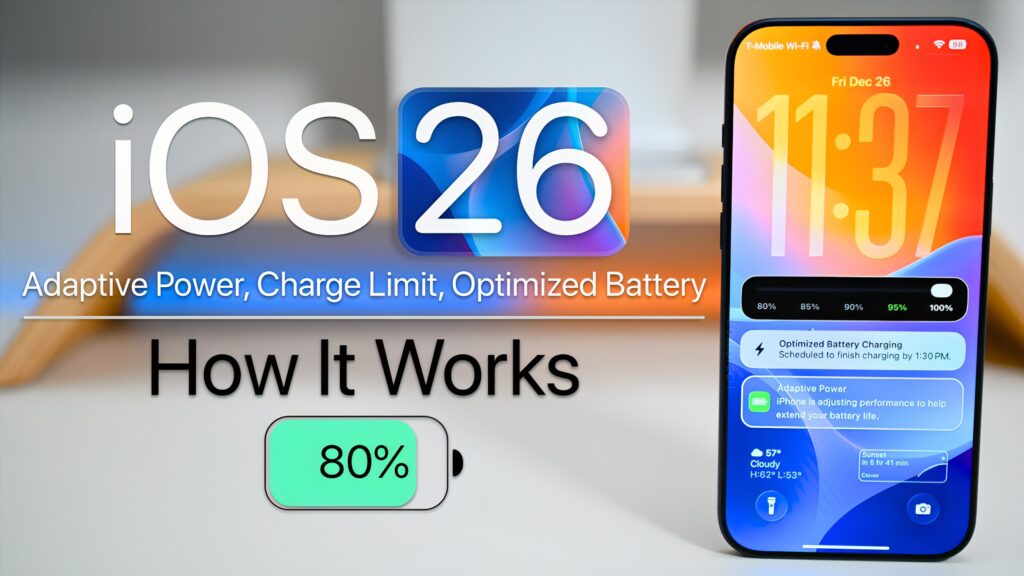
AI Power Management in Gaming, Video & Social Media
Different activities place different demands on your phone, and modern AI recognizes these distinctions, applying specialized optimization for each scenario.
Gaming Optimization:
Performance Prediction: AI analyzes the game being played and predicts performance requirements, allocating CPU/GPU resources efficiently.
Thermal Prevention: Monitors temperature and adjusts performance preemptively to prevent throttling (which actually increases power consumption).
Network Prioritization: Ensures gaming packets get priority on congested networks, reducing retransmissions that waste power.
Background Suspension: Intelligently pauses non-essential background processes during gaming sessions.
Video Streaming Intelligence:
Content-Aware Optimization: Recognizes whether you’re watching high-action content or static talking heads and adjusts decoding power accordingly.
Buffer Management: Intelligently manages video buffering based on network stability to minimize power-wasting retries.
Display Adaptation: Adjusts screen refresh rate and brightness based on video content and ambient lighting.
Audio Efficiency: Optimizes audio processing power based on content type (music vs dialogue vs effects).
Social Media Power Management:
App-Specific Profiles: Recognizes different social media apps have different power characteristics and applies tailored optimization.
Scroll Optimization: Predicts scroll patterns and prepares content in advance for smooth, power-efficient scrolling.
Media Loading Intelligence: Prioritizes loading visible content while delaying off-screen media loading.
Notification Batching: Groups notifications from social apps to reduce frequent wake-ups.
Camera & Photography Power Optimization:
Usage Prediction: Prepares camera resources when it detects you’re likely to take photos (based on location or time).
Processing Efficiency: Optimizes computational photography algorithms for power efficiency without compromising quality.
Flash Management: Intelligently manages flash power based on distance to subject and ambient light.
AI Battery Optimization in Budget vs Flagship Phones
A common misconception is that AI battery optimization is a premium feature. In 2026, the reality is more nuanced—both budget and flagship phones leverage AI, but with different approaches and capabilities.
Budget Phones ($200-400):
Efficiency-First Approach: Focus on maximizing battery life from limited hardware through intelligent resource management.
Basic Pattern Learning: Learns daily routines and applies straightforward optimization based on time and location.
Essential Adaptive Charging: Basic charging optimization focused on preventing overnight overcharging.
App Management: Identifies and restricts battery-draining apps, often with user approval prompts.
Strengths: Excellent value, focus on core optimization that delivers tangible battery life improvements.
Limitations: Less personalized, slower learning, fewer specialized optimizations for different activities.
Mid-Range Phones ($400-700):
Balanced Intelligence: Combines hardware efficiency with sophisticated software optimization.
Advanced Pattern Recognition: Learns more complex patterns including weekly variations and location-specific behaviors.
Comprehensive Adaptive Features: Full adaptive charging with health protection and irregular schedule handling.
Activity-Specific Optimization: Different optimizations for gaming, streaming, productivity, and photography.
Strengths: Best balance of features and value, sophisticated enough for most users’ needs.
Limitations: May lack cutting-edge AI features introduced in flagships first.
Flagship Phones ($700+):
Cutting-Edge AI: Latest machine learning models with faster adaptation and deeper personalization.
Predictive Intelligence: Anticipates needs before patterns are fully established through contextual understanding.
Ecosystem Integration: Coordinates battery optimization across multiple devices (watch, earbuds, laptop).
Advanced Health Protection: Sophisticated battery health monitoring and predictive maintenance.
Specialized Scenarios: Optimizations for professional use cases like photography, video editing, or AR applications.
Strengths: Most advanced features, fastest adaptation, best handling of edge cases and irregular usage.
Limitations: Premium price, sometimes over-optimized for average users.
The Sweet Spot:
For most users, mid-range phones in 2026 offer 80-90% of flagship AI battery optimization at 50-60% of the price. The improvements in budget phones are particularly dramatic, bringing meaningful AI optimization to price-sensitive segments.
Is AI Battery Optimization Safe for Privacy?
This is perhaps the most important question for many users: If my phone is learning this much about my habits, what happens to my privacy? The answer in 2026 is reassuring, thanks to fundamental shifts in how AI processes data.
On-Device Processing: The Privacy Foundation
Local Learning: The most significant privacy advancement is that pattern learning happens entirely on your device. Your daily routines, app usage, locations, and habits never leave your phone.
No Cloud Dependency: Unlike earlier systems that sent usage data to servers for analysis, modern AI battery optimization works completely offline once the initial models are installed.
Encrypted Storage: Learned patterns are stored in encrypted form on your device, inaccessible to apps or services.
What Your Phone Actually Learns (And What It Doesn’t)
Does Learn: Timing patterns, app usage frequencies, location categories (home, work, etc.), charging habits.
Doesn’t Learn: Specific app content, personal messages, private photos, precise locations unless necessary for optimization, sensitive information.
Transparency and Control
Privacy Dashboard: Most phones now include clear visualizations of what data AI systems are accessing.
Granular Controls: Users can disable specific learning features while keeping others active.
Learning Reset: Option to clear learned patterns and start fresh.
Incognito Modes: Temporary suspension of learning during sensitive periods.
Manufacturer Commitments:
Leading manufacturers have adopted privacy-by-design principles for AI features:
- Apple: On-device processing with differential privacy for aggregated learnings
- Google: Local AI processing with optional cloud enhancements
- Samsung: Knox-protected AI learning with user control panels
- Xiaomi: Privacy-focused AI with regular transparency reports
The Bottom Line:
Modern AI battery optimization is designed with privacy as a core requirement, not an afterthought. The systems that know the most about your habits are also designed to keep that knowledge most secure—on your device, under your control.
Related Guides You May Like
If you found this guide helpful, you might also enjoy these related articles:
👉 How AI Works Inside Smartphones – Discover the broader picture of artificial intelligence in modern smartphones beyond just battery optimization.
👉 Best Smartphones for Students 2026 – Find phones with excellent battery life and AI optimization perfect for academic life.
👉 How AI Improves Smartphone Cameras in 2026 – Learn how artificial intelligence is revolutionizing mobile photography.
👉 Best Smartphones 2026 – Find phones with excellent battery life 🔋 and smart AI optimization 🤖 perfect for daily use and productivity 📱✨
Final Thoughts: Smarter AI Means Longer Battery Life
The journey from simple battery saving modes to intelligent AI optimization represents one of the most significant—yet often overlooked—advancements in smartphone technology. What began as crude power management has evolved into sophisticated systems that understand our lives, anticipate our needs, and protect our devices’ long-term health.
As we look toward the rest of 2026 and beyond, AI battery optimization will become even more seamless and intelligent. We’re moving toward systems that don’t just react to our habits but proactively suggest changes that could improve both battery life and overall experience. The line between hardware and software optimization will continue to blur, with AI coordinating across processors, displays, networks, and sensors for maximum efficiency.
For consumers, this means focusing less on battery capacity numbers and more on AI optimization capabilities when choosing phones. The best battery life no longer comes from the biggest battery but from the smartest management system. Whether you’re considering a budget device or a flagship model, prioritize phones with proven AI optimization track records and long-term software support.
Remember: The most effective battery optimization is the one you don’t notice because it works so seamlessly with your life. As AI continues to evolve, our smartphones will become not just tools we charge but partners that understand our energy needs as well as we do.

Baqir Ali is the Founder of Baqir Digital Hub and a passionate SEO, AI, and Blogging specialist. With years of experience in digital marketing, he helps beginners and professionals grow online using smart content strategies, AI tools, and SEO best practices. His mission is to simplify technology and help people build sustainable online income.