
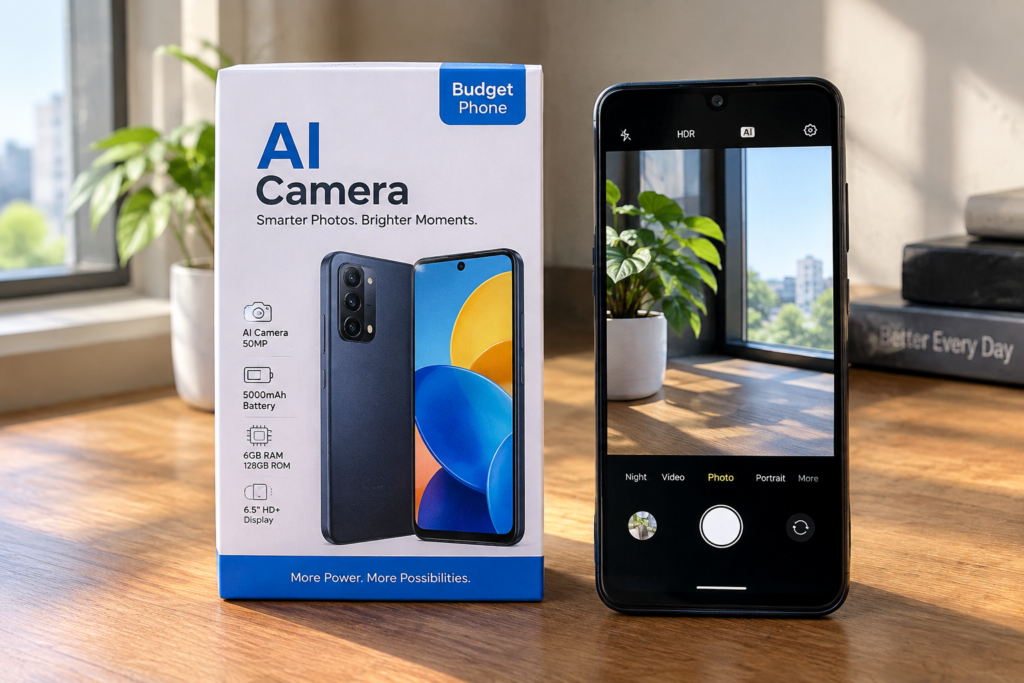
A friend of mine bought an Infinix Hot 70 last month for around PKR 65,000. The box said AI Camera. The salesperson said, AI-powered. He took it home, shot some photos at a family dinner, and sent them to me, asking why they looked softer than the samples he’d seen on YouTube. The phone wasn’t broken. It just wasn’t doing what the label implied.
That experience isn’t unusual. Walk through any mobile market in Pakistan and you’ll see AI Camera, AI Battery, and AI Engine printed on almost every box, from a PKR 25,000 itel to a PKR 125,000 Infinix Note. Some of those claims are backed by real hardware. Others are software features that have existed for years, now renamed for marketing.
This guide breaks down what AI actually means on a budget phone in Pakistan, which claims are worth paying for, and which ones you can safely ignore.
What AI Actually Means on a Phone
There are two very different things that get called AI on smartphones, and the difference matters.
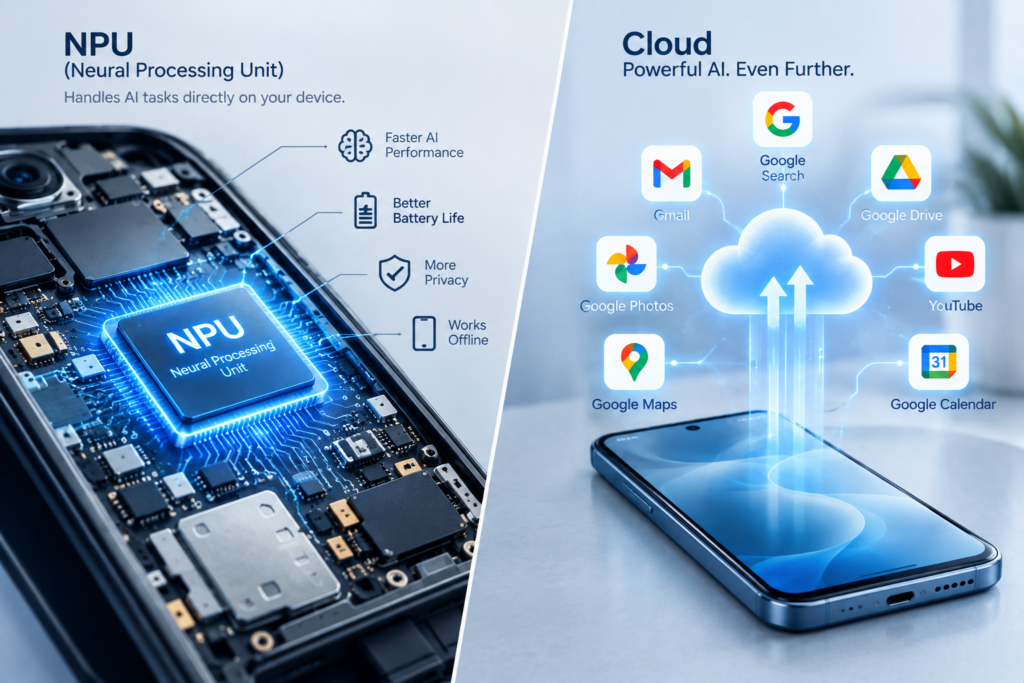
A dedicated AI chip (NPU). An NPU — Neural Processing Unit — is a separate piece of silicon designed specifically for AI tasks. It handles things like scene detection, noise reduction, and voice processing locally, without sending data to a server. Phones with a real NPU can do more AI work faster and more privately. MediaTek’s Dimensity 7000 series includes a sixth-generation NPU for AI-driven photography and on-device processing tasks Source: Croma.
Software algorithms run on the main processor. Many budget phones don’t have a dedicated NPU. Instead, they run lightweight AI models on the CPU or GPU, or they send the task to a cloud server. The phone still does something — but it’s slower, often requires internet, and can’t handle complex AI tasks. As one industry analysis put it, most budget phones relying on cloud computing turn back into ordinary phones once the internet is disconnected. Source: Sina.
Neither approach is automatically bad. But if you’re paying extra for AI, you should know which one you’re getting.
AI Camera Claims: What’s Real and What’s a Sticker
Camera is where budget phone marketing leans hardest on AI, and where the gap between claim and reality is widest.
What’s Usually Genuine
Scene detection and HDR. When your phone recognizes you’re shooting food and boosts the colors, or detects a backlit scene and adjusts exposure, that’s real computational photography. Even budget phones handle this. The itel City 200, for example, uses AI scene detection and HDR to handle harsh sunlight better than its predecessor Source: The Condia. This works because scene detection is a relatively light task — the phone identifies broad categories (indoor, outdoor, food, text) and applies a preset adjustment.
Basic noise reduction. Multi-frame noise reduction — where the phone takes several quick shots and averages out the grain — is genuinely AI-assisted on most phones now. The Helio G100 chip, used in several budget phones sold in Pakistan, includes AI noise reduction and multi-frame noise reduction as built-in features Source: FoneArena.
What’s Usually Hype
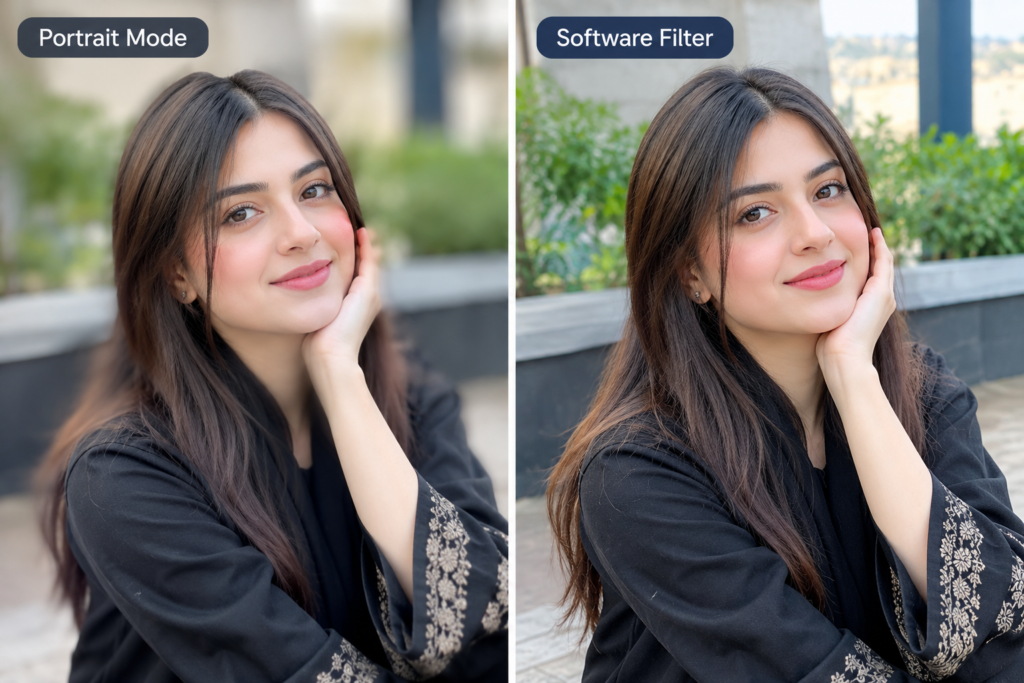
Portrait mode bokeh. On most phones under PKR 50,000, the blurred background you see in portrait mode isn’t true depth-sensing AI. It’s a software mask that guesses where the subject ends and the background begins. The result often looks fine on social media, but zoom in and you’ll see the edges of hair and glasses smeared or missed entirely. Real depth-sensing requires either a dedicated depth sensor or a powerful NPU — neither of which is common at this price point.
AI Zoom. Some budget phones advertise AI-enhanced zoom. In practice, this usually means the phone crops the image and applies sharpening — not the kind of detail recovery you’d see on a flagship with a periscope lens.
AI-generated wallpaper and themes. This is real AI, technically. But it’s a toy feature, not a photography improvement. Infinix’s One-Tap AI button, for example, gives access to AI wallpapers and themes Source: Infinix. Useful if you like it, irrelevant if you’re trying to take better photos.
AI Battery Claims: Mostly Genuine, With Caveats
Here’s the good news. Battery AI on budget phones is usually more honest than camera AI.
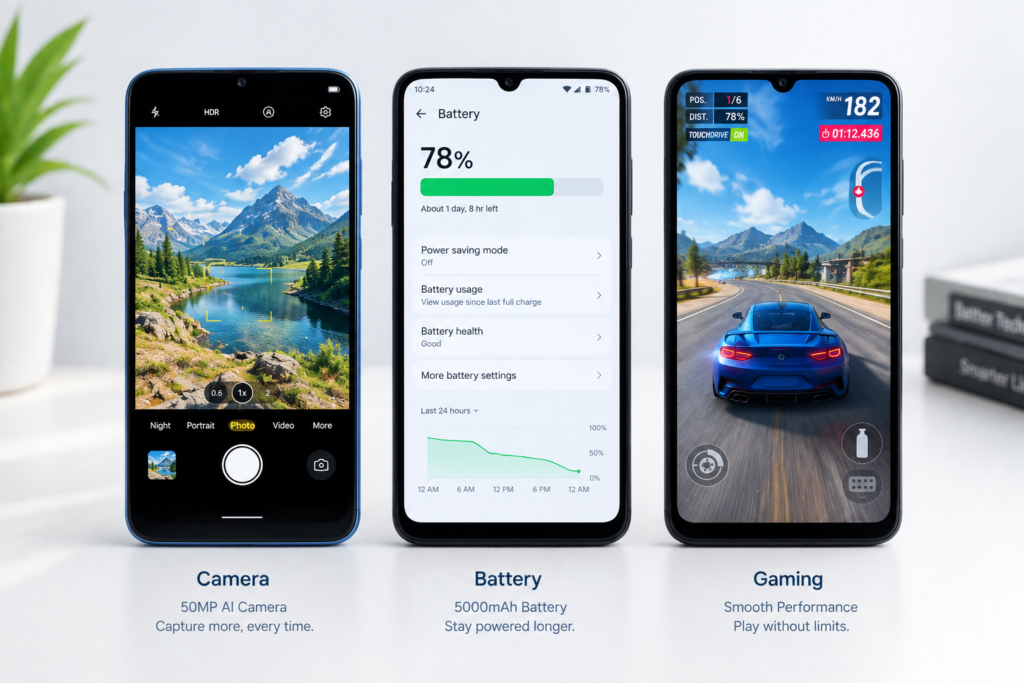
Adaptive battery features — where the phone learns your usage patterns and adjusts background activity — are genuinely useful even on cheaper hardware. The task is light enough that it doesn’t require a powerful NPU. Samsung, for instance, has brought AI-enhanced power management to its budget Galaxy A series, including features like background task optimization that rely on “lightweight machine learning models” rather than heavy processing Source: Banx Network.
That said, Adaptive Battery has a learning curve, and some users find it unreliable. One reviewer at MakeUseOf disabled Adaptive Battery on their Android phone because it was making decisions I didn’t approve, including delaying notifications from important apps Source: MakeUseOf. Another writer at XDA found that Samsung’s AI battery modes delivered “only a minuscule increase in battery life” compared to manual settings. Source: XDA Developers.
The takeaway: battery AI is real, but don’t expect it to double your screen-on time. It’s a 5-15% improvement in most cases, not a transformation.
AI Display and Gaming Claims: Mostly Marketing
If a budget phone advertises AI Display or AI Gaming, it’s usually referring to basic auto-brightness adjustment or refresh-rate switching — features that have existed for years without the AI label.
There’s no real-time AI optimization happening on most sub-PKR 60,000 phones during gaming. The processor is simply running as fast as it can, and the phone may reduce resolution or frame rate when it heats up. That’s thermal throttling, not AI.
One exception: some MediaTek chips, like the Dimensity 7100, include Adaptive Gaming Technology for power efficiency . Source: Croma. But this is still basic resource management, not the kind of predictive AI you’d find on a flagship.
Real Examples Across Price Tiers
Entry Level (~PKR 25,000–35,000)
Examples: itel City 200 (PKR 28,999), Tecno Spark Go 3 (PKR 29,999)
At this price, AI mostly means software features and cloud-based assistants. The itel City 200 has AI Auto Zoom for selfies and AI Vlog features Source: itel Pakistan. The Tecno Spark Go 3 includes the Ella AI voice assistant and AI scene enhancement Source: TechJuice. These are real features, but they’re basic. The AI assistant often needs internet. The camera AI is limited to scene presets.
A review of the Tecno Spark Go 3 on WhatMobile was blunt: The phone can handle a bit of AI tasks… Basically it’s the same old stuff repackaged in a new bottle, nothing more than that. Source: WhatMobile.
Mid-Range (~PKR 45,000–75,000)
Examples: Infinix Hot 70 (PKR 64,999), Tecno Camon 50 (PKR 74,999)
This is where genuine AI hardware starts appearing. The Infinix Hot 70 runs on the MediaTek Helio G100 Ultimate, a 6nm chip that includes AI face detection, hardware depth engine, and AI noise reduction Source: FoneArena. The Hot 70 also has a physical One-Tap AI button that launches Folax, Infinix’s AI assistant, with access to five AI models including ChatGPT and Gemini Source: Infinix.
But AI here is still mostly about convenience, not photography magic. A review on YugaTech noted the One-Tap AI button was the standout feature — useful for quick access, not for transforming image quality . Source: YugaTech.
Upper Mid-Range (~PKR 80,000–100,000+)
Examples: Tecno Camon 50 Pro (PKR 85,999), Infinix Note 60 Pro (PKR 125,999)
At this level, you start seeing real AI processing power. The Camon 50 Pro includes AI Auto Zoom that tracks subjects, AI Light Master 2.0 for removing reflections and shadows, and an AI image-to-video generator Source: TECNO. The Infinix Note 60 Pro has a Dimensity 7100 chip with a dedicated NPU Source: Croma.
These phones can do meaningful AI work on-device. But they’re also competing with last-generation flagships from Samsung and Google, which often offer better AI camera processing at similar prices.
Practical Checklist Before You Buy
Check the chipset, not the sticker. Search for the exact chip name + NPU or AI capabilities. If the manufacturer’s spec page doesn’t mention an NPU, the phone is likely running AI on the CPU or in the cloud.
Read reviews, not spec sheets. Spec sheets list AI Camera as a feature. Reviews tell you whether the photos actually look good. Look for reviews that show sample images in different lighting conditions.
Don’t pay a premium for AI. If a phone costs PKR 10,000 more than a similar model solely because of AI branding, ask what specific AI feature you’re paying for. In many cases, the non-AI version performs identically.
Test the camera in the shop. Take a portrait photo and zoom in on the edges. If the blur looks unnatural or the edges are smeared, that’s software bokeh, not AI depth sensing.
Check if AI features need internet. Cloud-based AI features won’t work without data. On-device AI works offline. If the salesperson can’t tell you which is which, the phone probably doesn’t have a dedicated NPU.
FAQ
Is AI on a budget phone completely fake?
No. Battery optimization, scene detection, and noise reduction are genuinely AI-assisted on most budget phones. But AI Camera often refers to software presets rather than true AI processing. The features are real; the marketing exaggerates what they can do.
What is an NPU, and why does it matter?
An NPU is a dedicated chip for AI tasks. Phones with an NPU can run AI features faster, offline, and more privately. Budget phones without an NPU rely on the main processor or cloud servers, which is slower and often requires internet.
Should I avoid phones without an NPU?
Not necessarily. If you mainly use your phone for calls, social media, and casual photos, a phone without an NPU will serve you fine. The AI features it does have — battery optimization, basic scene detection — work well enough. You only need an NPU if you want advanced on-device AI for photography or voice tasks.
Why do budget phone photos look worse than the samples?
Sample photos are often taken by professional photographers in ideal lighting, using a different phone model or a pre-production unit. In real-world conditions — indoor lighting, moving subjects, low light — budget phone cameras struggle. The AI can only do so much with limited hardware.
The Sticker Isn’t the Feature
AI on a budget phone in Pakistan isn’t meaningless. Some of it is real, useful, and worth having — especially battery optimization and basic scene detection. But a significant portion of what gets marketed as AI is either basic software that’s been around for years or a feature that only works with an internet connection.
The next time you’re in a mobile shop and the salesperson points to an AI Camera sticker, ask one question: what does it actually do differently? If the answer is that it detects scenes, that’s fine — most phones do that. If the answer is that it has a dedicated AI chip, ask for the chip name and look it up.
Your PKR 30,000 doesn’t need to buy fake AI. It needs to buy a phone that does the basics well.
Sources and Last Checked
Prices and specifications verified against Pakistani tech outlets and manufacturer pages in September 2026. Chipset AI capabilities sourced from MediaTek, Qualcomm, and independent hardware reviews. Prices fluctuate; check current listings before buying.
I’m not affiliated with Infinix, TECNO, itel, Samsung, or MediaTek. Opinions here are based on published reviews and manufacturer specifications.
🔗 Related Guides on Baqir Digital Hub
- Google Pixel 11 Series 2026: Everything You Need to Know — What real flagship AI looks like in 2026.
- AI RAM Management in Smartphones 2026: How AI Makes Your Phone Faster — How AI handles memory on phones at different price points.
- AI Personal Health Monitoring in Smartphones 2026 — Which health AI features actually work, and on which phones.
Disclaimer
The images used in this article are AI-generated for illustrative purposes. Product details, pricing, and specifications are based on official manufacturer pages and independent tech reporting linked throughout the article. Prices in Pakistan change frequently — check current listings before buying.
Written by Baqir Ali
Founder of Baqir Digital Hub | AI & Smartphone Researcher
Baqir has been covering AI and smartphone technology since 2024, helping readers understand the real-world impact of emerging tech. His work focuses on making complex topics simple, practical, and actionable.

Baqir Ali is the Founder of Baqir Digital Hub and a passionate SEO, AI, and Blogging specialist. With years of experience in digital marketing, he helps beginners and professionals grow online using smart content strategies, AI tools, and SEO best practices. His mission is to simplify technology and help people build sustainable online income.